Resources
Also on this page:
EECD Policies
PBIS has engaged our students, staff, and community to look at a new ways of doing business in schools; focused on positivity, collaboration and data-driven decisions.
Brad MacDonald
Principal, Rothesay High School, ASD-South
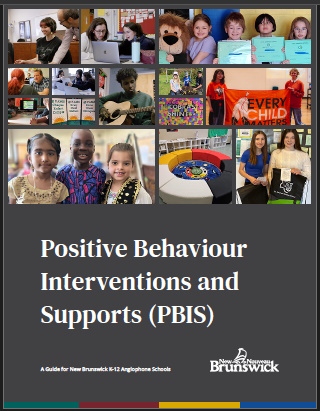
Frequently Asked Questions on PBIS in New Brunswick
Check out answers to FAQ to help you get started with PBIS in your school.
Author
NB PBIS TEAM
New Brunswick Positive Interventions Support Research
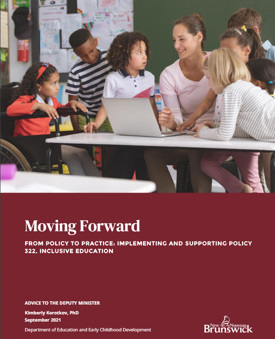
Inclusive education within New Brunswick Education is an evolving and systemic model where children reach their full learning potential, supported by decisions that are based on the individual needs of students and founded on evidence. Over the past 35 years, since inclusive education was legislated, there has been a continuing evolution from viewing inclusive education through a disability-focused lens to viewing it as a
model that focuses on all students.
Author
Kimberly Korotkov, PhD
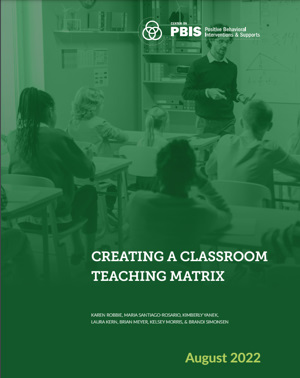
Creating A Classroom Teaching Matrix
This brief focuses on how to promote a positive teaching and learning environment by establishing positive classroom expectations, or norms, that reflect the shared values of a classroom community (i.e., educators, students, families). Specifically, this brief provides guidance for creating and using a classroom teaching matrix to explicitly identify, define, and teach (a) predictable classroom routines, (b) positive classroom expectations, and (c) critical social, emotional, and behavioral (SEB) skills.
Authors
Karen Robbie, Maria Santiago-Rosario, Kimberly Yanek, Laura Kern, Brian Meyer, Kelsey Morris, Brandi Simonsen
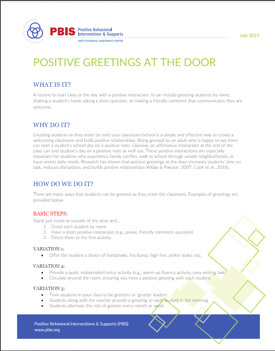
Positive Greetings at the Door – Practice brief
A routine to start class or the day with a positive interaction. It can include greeting students by name, shaking a student’s hand, asking a short question, or making a friendly comment that communicates they are welcome.
Author
Positive Behavioral Interventions & Supports (PBIS)
www.pbis.org
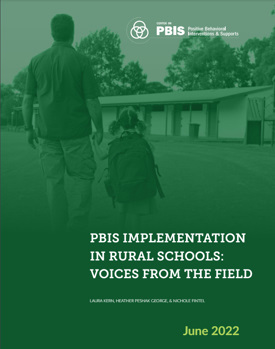
PBIS Implementation In Rural Schools: Voices From The Field
This brief summarizes themes from interviews with seven district- and school-level leaders who were asked to share experiences and lessons learned while implementing PBIS in their rural school(s).
Authors
Laura Kern
Heather Peshak George
Nichole Fintel
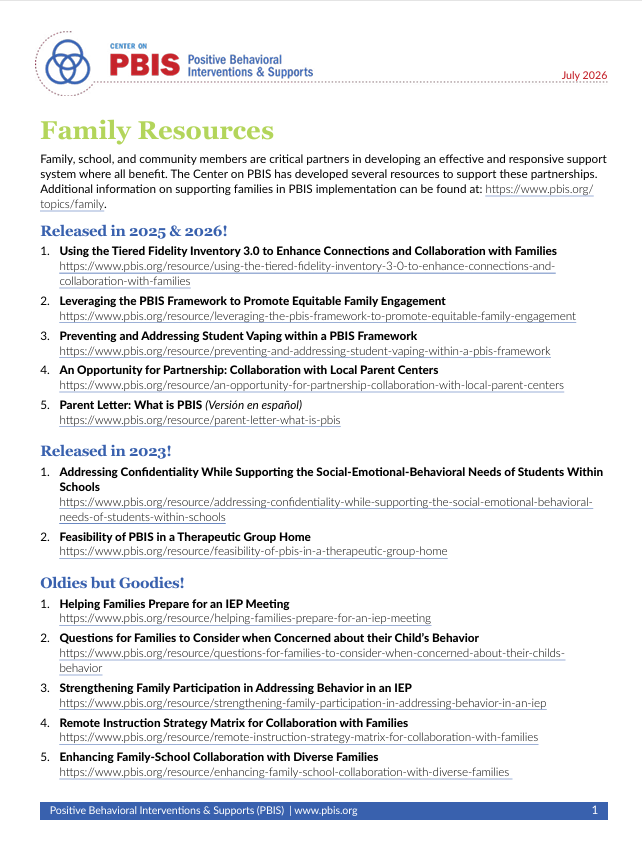
The Center on PBIS has developed several resources to support critical partnerships with family, school, and community members
Authors
Center on Positive Behavioral Interventions and Supports (2026). Family Resources. Center on PBIS, University of Oregon.
www.pbis.org
Supporting Deaf Students in the Classroom within a PBIS Framework
This document provides information to contextualize PBIS in the classroom for deaf students to better address unique needs and create more effective learning environments. Guided by PBIS core features, “top ten” practices are identified to support and respond to students’ social, emotional, and behavioral needs in the classroom with considerations for deaf students.
Authors
Center on PBIS, National Center on Deafblindness, National Deaf Center on Postsecondary Outcomes. (October 2023). Supporting
Deaf Students in the Classroom within a PBIS Framework. Center on PBIS, University of Oregon. www.pbis.org
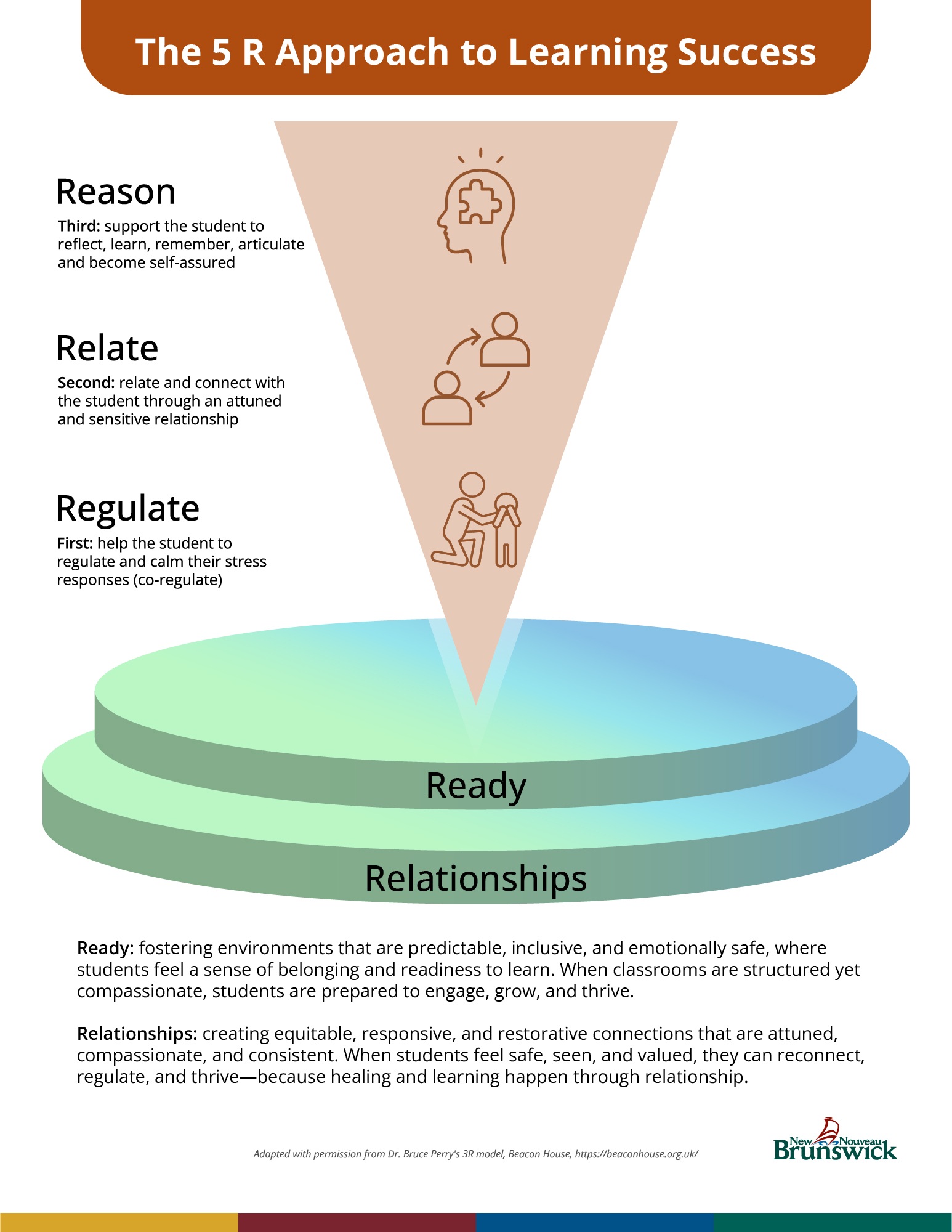
The 5R Approach to Learning Success
A trauma-informed framework adapted from Dr. Bruce Perry’s 3R model. It provides a lens for creating the conditions students need to feel safe, connected, regulated, and ready to learn.
Ready • Relationships • Regulate • Reason • Repair
The 5 Rs complement Positive Behaviour Intervention Supports (PBIS) by reinforcing its proactive, inclusive, and relationship-centred approach. Together, they support schools in creating predictable environments, building strong relationships, teaching behavioural and social skills, supporting regulation, and using restorative approaches when challenges occur.
In practice, the 5 Rs help us remember that positive behaviour and learning are built through connection, predictability, teaching, and support—not simply through responding when behaviour occurs
Authors
Department of Education and Early Childhood Education, NB.
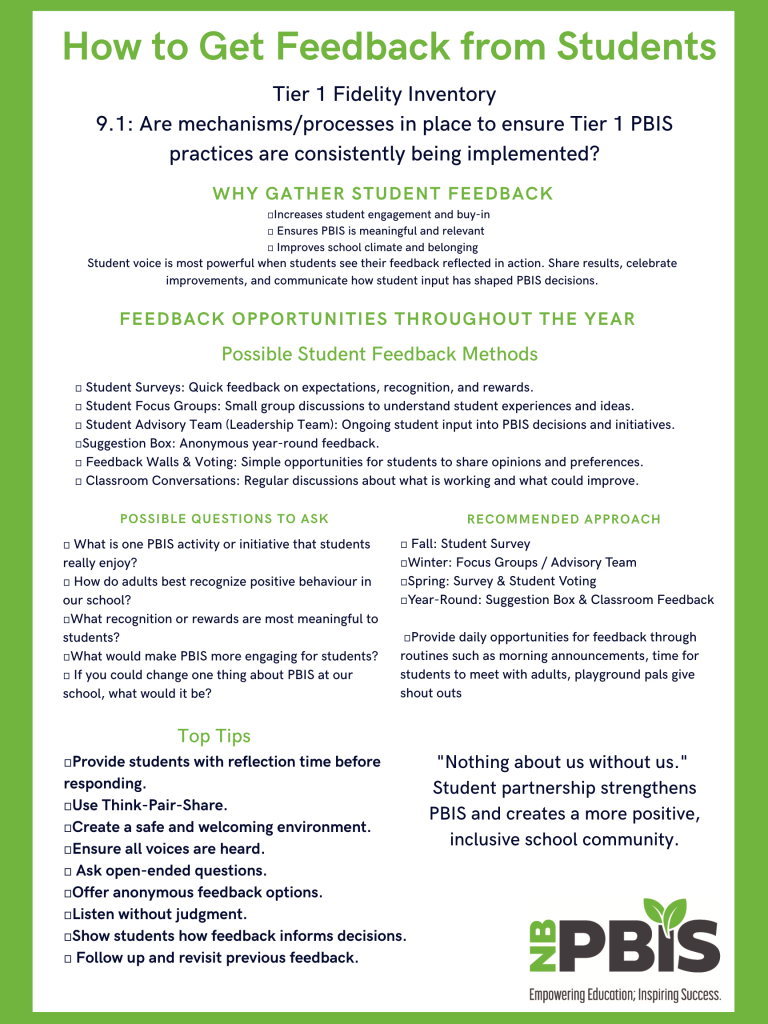
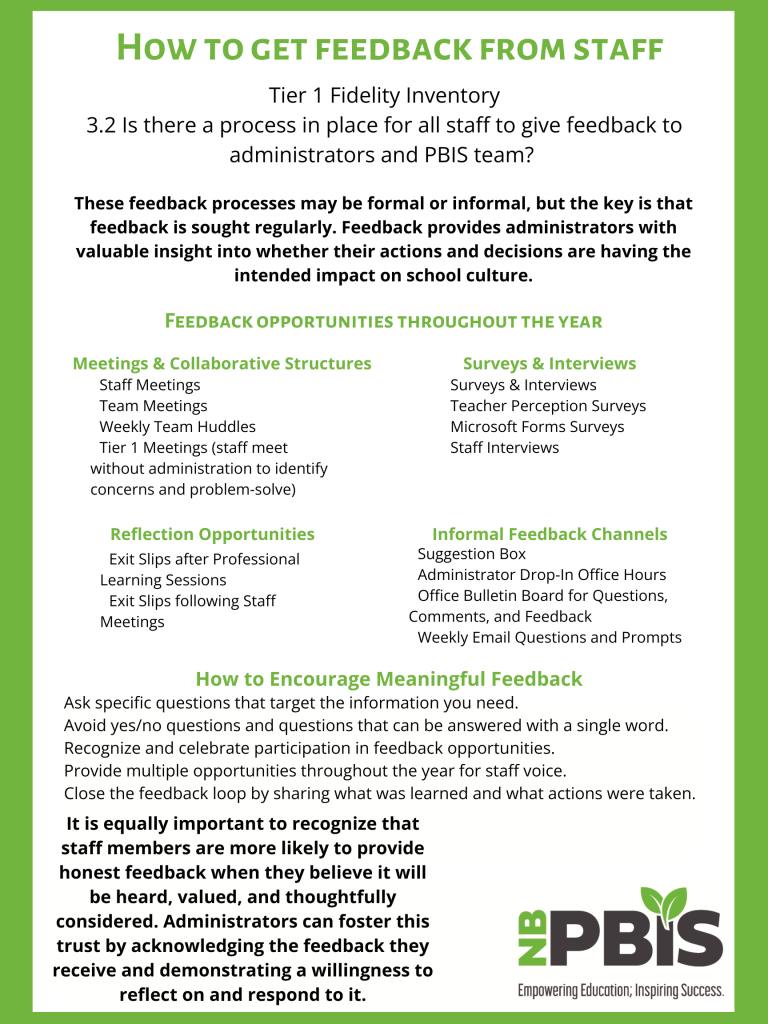
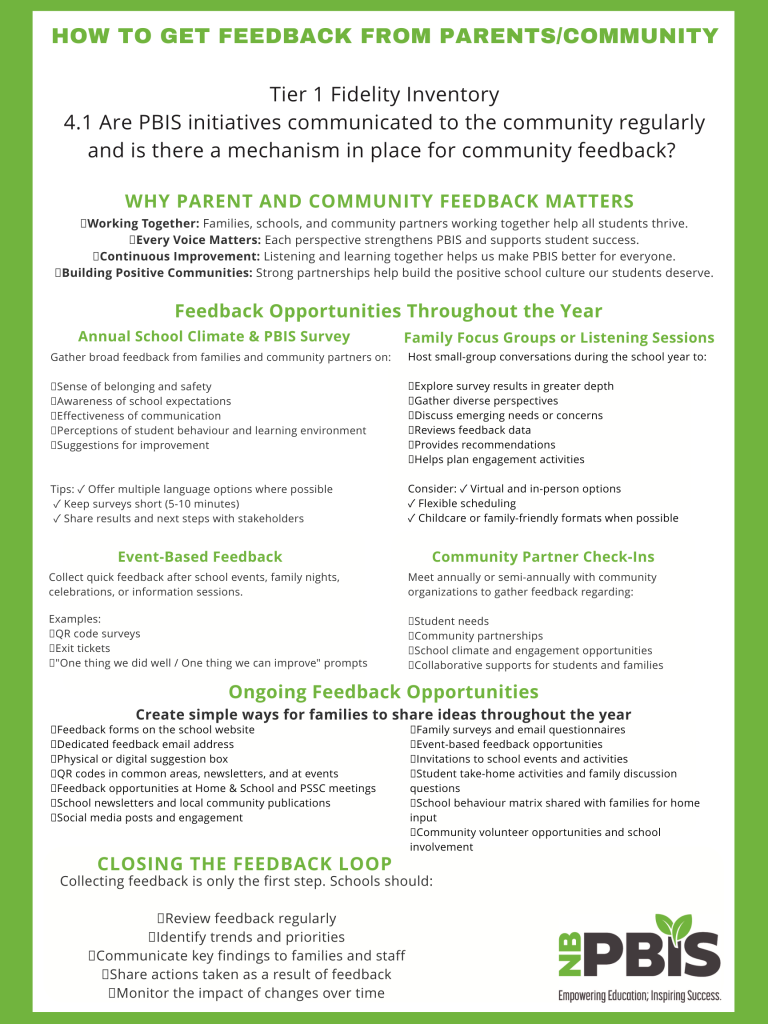

New Brunswick’s proactive approach to PBIS for an equitable inclusive system serves as an exemplar for the importance of promoting positive behaviour for every learner. Leaning into the idea that all learning is relational, schools have worked diligently to enhance relationships and to engage with learners and their families, staff, and communities. This personalized, strengths-based approach has been very successful, and highlights the dedication and passion that NB educators exhibit every day.
Dr. Kimberly Korotkov,
Senior Director: Integrated Support Services Alignment,
Department of Education and Early Childhood Development, New Brunswick, Canada
Department of Education and Early Childhood Development Policies
POLICY 322 – Inclusive Education
POLICY 701 – Policy for the protection of Pupil
POLICY 703 – Positive Learning and Working Environment
POLICY 705 – School and School District Crisis Planning
POLICY 713 – Sexual Orientation and Gender Identity